Deep Impact Spiritual Event
Introduction to the Deep Impact Spiritual Event.
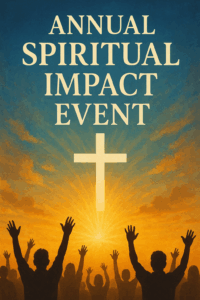 Church decline in the 21st century is rarely caused by a single problem. It is usually a convergence: thinner attendance habits, exhausted volunteers, fractured trust in institutions, shifting generational expectations, and an ambient sense that “church life” is busy without being spiritually consequential. Many congregations respond by multiplying programs, adding new service times, or revising worship styles, efforts that can help, but often fail to address the deeper need: a shared, congregational experience of spiritual renewal that is focused enough to change hearts and structured enough to re-shape the ministry calendar.
Click this link to view book on Amazon. https://amzn.to/4t0xz6S
As an Amazon Associate, I earn from qualified purchases.
A Deep Impact Spiritual Event is a practical answer to this need. It is not merely an “extra event” added to an already crowded year. It is a high-focus, once-a-year spiritual catalyst designed to reset the congregation’s spiritual temperature, renew mission clarity, and activate evangelistic energy. Dale R. Turner’s framework in Annual Spiritual Impact Event argues that one intentional weekend, planned with spiritual depth and strategic clarity, can become the hinge upon which the entire ministry year turns. The event is not hype; it is a repeatable process that blends prayer, preaching, testimony, invitation, and mission alignment into a single concentrated experience that produces lasting effects.
What is a Deep Impact Spiritual Event?
 A Deep Impact Spiritual Event is a concentrated spiritual gathering—often over a weekend or a defined multi-day sequence—built around a simple idea: one shared encounter with God can re-order priorities, re-ignite faith, and re-orient a congregation toward mission. Turner’s model places the event within an annual schedule and treats it as a “spiritual anchor” that shapes the church calendar rather than competing with it. In this model, the event becomes the congregation’s yearly “spiritual summit,” the moment when the church collectively seeks God with intensity, reclaims gospel identity, and recommits to discipleship and outreach.
The event is “deep impact” because it is designed for transformation rather than consumption. The goal is not “a good turnout,” but changed lives. It is not a special service performed by professionals, but a congregational movement in which people come expecting Christ to meet them, heal them, forgive them, restore them, and send them.
Click link below to see Linkedin article.
Why the effects can be strong and lasting with the Deep Impact Spiritual Event.
Skepticism is understandable: churches have hosted revivals, guest speakers, and special weekends for generations. Why would an annual event now produce lasting impact when so many “special services” fade quickly?
The difference lies in intentionality, integration, and follow-through. Deep Impact Spiritual Event.
 Intentionality: A deep impact event is planned as spiritual formation, not event management. That means prayer saturation, clear preaching centered on the gospel, carefully chosen themes, testimony that normalizes transformation, and specific invitations that call for response (repentance, renewed faith, healing, reconciliation, vocational calling, or commitment to discipleship). Turner emphasizes that the event must be more than inspirational; it must be structured toward spiritual decisions that can be acted upon afterward.
Integration into the annual calendar: The event is not a one-off “extra.” It becomes the annual reset—a moment that sets direction for the rest of the year. When the event is integrated into planning, budgeting, volunteer recruiting, sermon series alignment, and outreach rhythms, it creates continuity between the spiritual “high point” and the church’s ordinary life. The event becomes a launchpad rather than a fireworks display.
Follow-through systems: Lasting impact requires pathways. People who respond to Christ need next steps: mentoring, small groups, baptism preparation, spiritual practices, service opportunities, and ongoing pastoral care. In Turner’s framework, the event is designed with a “before and after” strategy. What happens in the room must lead to what happens in homes, small groups, and everyday discipleship.
Lasting effects happen because the event creates shared memory and shared meaning. Sociologically, communities bond through common experiences; spiritually, the church is renewed when it shares a common moment of repentance, joy, surrender, and recommitment. Such moments become reference points: “Remember when God met us.” Those reference points strengthen identity, encourage perseverance, and foster unity.
How an annual schedule can reverse the trend of church decline with the Deep Impact Spiritual Event.
Church decline is often discussed in terms of demographics and cultural secularization, but the most immediate driver at the congregational level is frequently loss of spiritual momentum. When momentum is lost, attendance becomes optional, giving becomes hesitant, volunteerism becomes scarce, and outreach feels awkward rather than natural.
A Deep Impact Spiritual Event can reverse these patterns because it addresses the core realities that drive decline:
1) It rebuilds spiritual expectation.
Many churches gradually train people not to expect much—good music, a decent sermon, friendly conversation, and then home. A deep impact event retrains the congregation to expect God to act: to convict, heal, restore, save, and call. When expectation rises, participation rises. People invite others when they believe something meaningful will happen.
2) It re-centers mission.
Decline often accelerates when a church loses clarity about why it exists. The annual event can function as a mission re-centering: a moment when the church remembers the gospel, remembers the Great Commission, and remembers that spiritual life is meant to overflow into witness and service. Turner’s approach frames the event as a catalyst for renewed evangelism and community impact—connecting spiritual renewal to outward fruit.
3) It reactivates the “fringe”.
 Every church has people on the margins—sporadic attenders, weary volunteers, those quietly hurt, those uncertain about faith, those who have drifted into passive Christianity. A concentrated spiritual event gives those people a moment of re-entry. Because it is marked and special, it lowers the barrier to return: “I’ll come for that weekend.” And once reconnected, follow-up systems can move them from the edges into belonging.
4) It strengthens leadership and volunteer culture.
Volunteer burnout often arises when people feel they are sustaining “maintenance religion” rather than participating in a living mission. A deep impact weekend renews volunteers by reminding them that their labor serves eternal purpose. When leaders build the year around a spiritual summit, volunteers can see the story arc of their effort. Their service is not endless grind; it is preparation for a meaningful harvest.
5) It creates an evangelistic invitational moment.
Many Christians hesitate to invite friends to weekly services because the invitation feels ambiguous: “You should come sometime.” An annual event creates a clear, specific invitation: “Come with me this weekend—our church is doing something focused on renewal.” The event becomes a community-wide outreach moment, especially if it includes testimonies, clear gospel preaching, and opportunities for prayer and response.
Decline is not reversed by a single weekend alone. It is reversed when the weekend becomes a yearly engine, a repeating cycle of prayer, preparation, proclamation, response, and follow-up that reshapes congregational habits.
A personal relationship with Jesus Christ at the heart. Deep Impact Spiritual Event.
If a Deep Impact Spiritual Event is only about attendance, branding, or emotional intensity, it will not endure. Its heart must be a living encounter with Jesus Christ—not merely information about Him, but relationship with Him.
A personal relationship with Christ means: a Deep Impact Spiritual Event.
Conversion and new birth: People are invited to repent, trust Christ, and begin a new life in Him.
Renewal for believers: Those already in the faith are invited to return to first love, surrender hidden sins, and receive fresh grace.
Healing and restoration: People bring wounds, grief, bitterness, shame, and spiritual dryness into Christ’s presence, receiving prayer and pastoral care.
Discipleship and obedience: Relationship is not merely feeling close to Jesus; it is learning to follow Him in everyday life through Scripture, prayer, community, and mission.
This event framework consistently points toward this center: churches do not ultimately grow by better religious programming; they grow when people meet Jesus, and when the church builds structures that help them keep following Him after the event ends.
Why the modern church needs an event. Deep Impact Spiritual Event.
“Event” can sound like marketing language, but biblically and historically, God often uses concentrated moments to catalyze change. People are shaped by rhythms and seasons: retreats, camp meetings, revivals, conferences, sacred seasons of fasting and prayer. The church has always needed both ordinary discipleship and extraordinary moments that call people to decision and re-commitment.
The modern church needs an event for several reasons: Deep Impact Spiritual Event.
Attention is fragmented. People live in constant distraction. A focused event creates a boundary in time:
“These days are different.” It gives people permission to disengage from noise and lean into spiritual seriousness.
Faith has become private and optional. An event gathers the community into a shared encounter, reminding people that Christianity is not only individual belief, but communal life centered on Christ.
Trust has eroded. Many people distrust institutions but still hunger for authenticity. A deep impact event can demonstrate authenticity through testimony, prayer, humility, and clear gospel preaching that is not manipulative. When people experience sincerity, trust can begin to rebuild.
Church calendars can become cluttered. A single annual anchor can simplify the year. Instead of constant low-grade busyness, the church organizes around a primary spiritual emphasis that gives coherence to ministry.
Generations need embodied experiences. Especially for younger generations, belief is often evaluated by lived experience: “Is this real? Does it change anyone?” A deep impact event, done well, provides an embodied encounter with worship, community, prayer, repentance, and mission.
Making the impact last: what must happen before and after.
For a Deep Impact Spiritual Event to create the “strong, lasting effects” the book emphasizes, churches need to plan beyond the weekend.
Before the event:
A season of congregational prayer and fasting.
Leadership unity and clear vision.
Personal invitations to unchurched friends and neighbors.
Alignment of music, preaching, testimony, and prayer ministry toward a single spiritual aim.
Communication that sets expectations: “Come ready for God to meet you.”
After the event:
Clear next steps the same day: small groups, classes, mentoring, baptism, service teams.
Follow-up contact within 48 hours for those who respond spiritually.
Sermon series and discipleship rhythms that reinforce the event theme.
Ongoing testimonies that normalize transformation (“Here’s what God is doing since the event”).
Evaluation not merely of attendance, but of spiritual fruit: conversions, restored relationships, renewed prayer life, increased service, community outreach.
One weekend can change a year, if it becomes a yearly rhythm as Deep Impact Spiritual Event.
A Deep Impact Spiritual Event is not a substitute for faithful weekly worship, preaching, sacraments, pastoral care, and discipleship. It is a catalyst, a concentrated moment that reawakens a church’s spiritual life and resets its mission focus. The Annual Spiritual Impact Event offers a compelling vision: churches can move from stagnation to sustained vitality when they commit to a repeatable, annual rhythm of renewal that is spiritually deep and strategically integrated.
At its heart, the event is not about the church’s survival; it is about Christ’s lordship. When a congregation gathers with expectancy, calls people to a personal relationship with Jesus, and builds a calendar around a yearly renewal summit, decline does not have to be the final story. The church can regain momentum, one Spirit-filled weekend at a time, until the weekend becomes more than an event: it becomes a pattern of life.
More Dale Turner Blogs. Click to view.
https://21stcenturyrenewalministries.com/2026/01/20/rethinking-the-church-calendar/
https://21stcenturyrenewalministries.com/2026/01/15/one-weekend-changes-churches
https://21stcenturyrenewalministries.com/2026/01/12/angels-pinheads-matter-spirit/
https://21stcenturyrenewalministries.com/2026/01/06/the-power-of-one-weekend/
https://21stcenturyrenewalministries.com/2026/01/05/dale-turner-pastor-author/
https://21stcenturyrenewalministries.com/2026/01/04/spiritual-impact-event-benefite/
https://21stcenturyrenewalministries.com/2026/01/03/spiritual-impact-event/
https://21stcenturyrenewalministries.com/2026/01/02/artificial-intelligence-and-christians/
https://21stcenturyrenewalministries.com/2025/12/31/fear-of-artificial-intellengence/
More Dale Turner Books. Click links to view.
The First 100 Days https://amzn.to/3NaoyYy
Annual Spiritual Impact Event https://amzn.to/4sSyoP8
Your New Life in Christ https://amzn.to/49PifSS
TLC Groups for Busy Disciples https://amzn.to/45aVWV8
Difficult Questions for Christians https://amzn.to/4sIsgce
Angels & Pinheads, Matter & Spirit https://amzn.to/49AncxF
How to Conquer the AI Conquest? https://amzn.to/4jNf4hZ
The Unique You. https://amzn.to/4aT5s2V
Why Bears Wear Socks. https://amzn.to/4raXA1J
31 Ways to Overcome Doubt https://amzn.to/4jAhBfg
31 Ways That You Can Be Rich https://amzn.to/45PwGUu
31 Ways to Tackle Anxiety https://amzn.to/3Naq398
31 Connections Conquer Depression https://amzn.to/3NHBu8f
31 Reasons Have Hope for the Future https://amzn.to/4sIcpKE
31 Ways That Forgiveness Transforms https://amzn.to/4sDMF1W
Living Forward Skills Every Generation https://amzn.to/3Lg26N4
Kinfolk Wisdom: What We Pass On https://amzn.to/4pxyIQb
How to be Wise at Any Age https://amzn.to/4qPy8yk
Following Jesus, Not Institutions https://amzn.to/3M5zo1F